Deutsche Bank analysts have painted a bullish outlook for the global solar market, noting that solar PV is about to enter a “third growth phase” where it can be deployed without subsidies, and can resist a backlash from utilities.
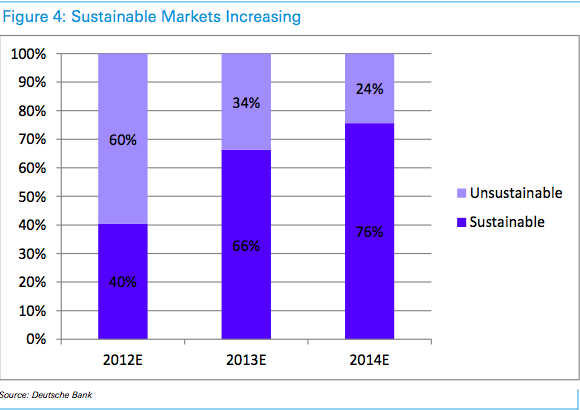
The report by analysts led by US-based Vishal Shah estimates that three-quarters of the world’s market will be “sustainable” for solar within 18 months, meaning they can operate with little or no subsidy. (see graph at end of story). In two years, the market for solar will have flipped from one largely “unsustainable” – needing big subsidies – to one mostly sustainable.
That’s because with module prices stabilising at around $US60c-70c/watt, and installation costs of around $US1-$US1.20 a watt, the levellised cost of solar electricity is between US10c-20c/kWh.
Deutsche Bank said that although the market in Europe had contracted, at least one third of new, small to mid size projects were being developed without subsidies. Multi-megawatt projects were being built south of Rome for €90c/W. This was delivering electricity costs (LCOE – with 80 per cent self consumption) of around €80/MWh (€8c/kWh)
In India, unsubsidised large scale projects are being bid at US12c/kWh, and power purchase agreements were being written for solar projects in the US at $US9c/kWh.
But it also noted that distributed solar (or rooftop or local ground-mounted solar) was also likely to take a signficant share of the solar market as leasing models became more mainstream and various markets adopt policies to support the technology.
It said innovative financing was the key – and could lead to growth in above all expectations if new sources of low cost capital is made available for the sector.
It also noted that the speed of the sector’s transition to grid parity meant that most governments are “somewhat behind the curve” in adjusting regulation to promote the desired growth of the solar sector over the next several decades.
And it said the solar sector could also continue to face significant backlash from major utilities as this “disruptive technology” is clearly a big threat to the their business model.
But it said rising electricity prices, a need for competitive generation sources, and lowered balance of system costs will drive further improvement over the next several years. And despite the backlash from major utilities, solar and distributed generation would continue to gain significant share of new capacity.
“We believe solar will appear increasingly attractive in a long term environment of rising electricity prices and fuel price uncertainty.“
However, Deutsche Bank warned that being at grid parity on paper does not necessarily equate to a robust market.
“We believe overall grid capacity, demand, and regulatory constraints will prove to be significant hurdles in many countries going forward. As more markets reach cost competitiveness over the next 3-5 years, we expect sustainable demand to ramp accordingly as governments adopt more sustainable policies and consumers recognize the value proposition
“Solar appears to be in the beginning stages of transitioning between ‘alternative energy’ and a truly cost competitive source of energy that may help both producers and consumers hedge against rising electricity rates and fuel costs.”
Source http://cleantechnica.com/2013/08/02/solar-pv-about-to-enter-third-growth-phase-deutsche-bank/